
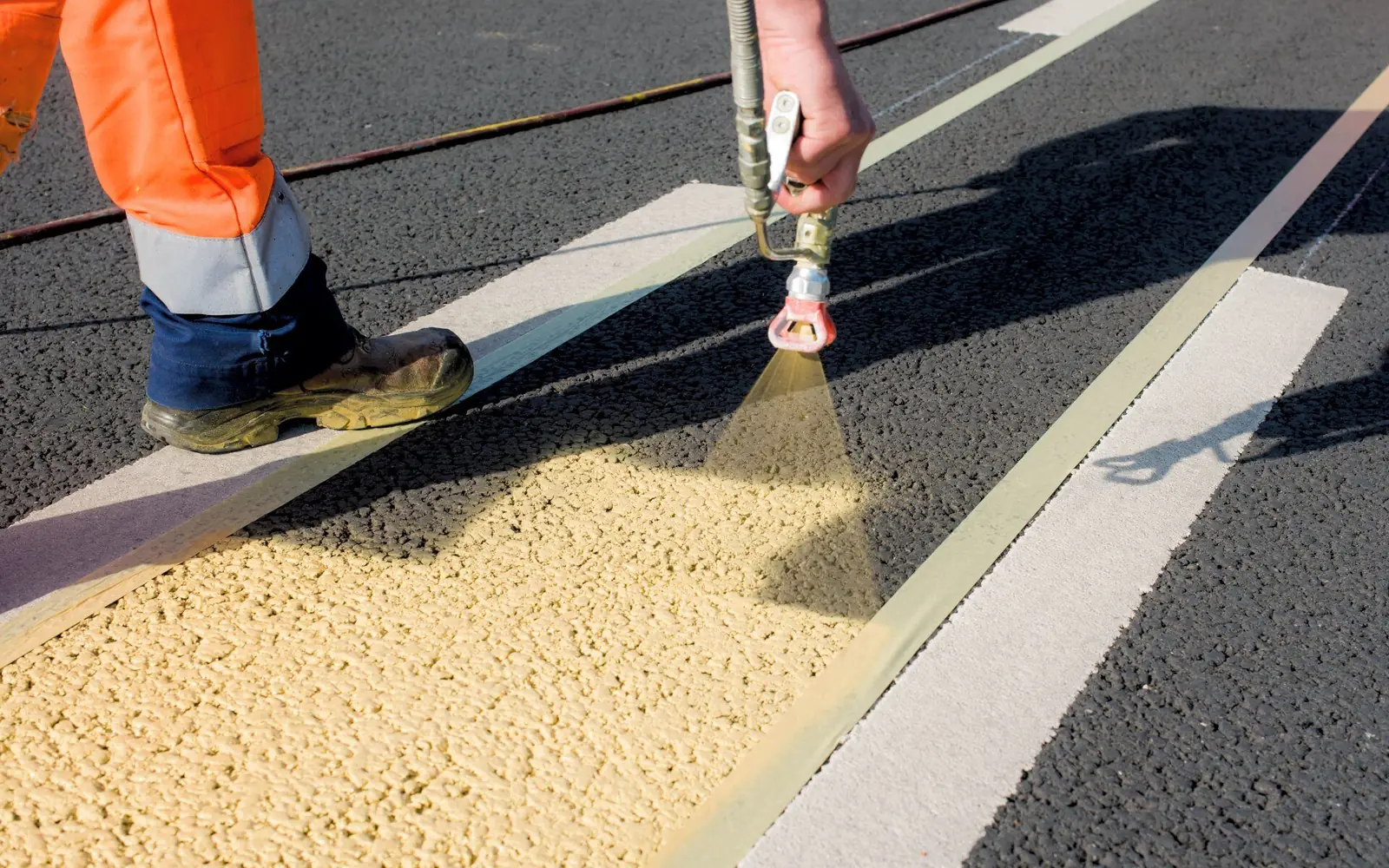
Line Marking in Middlesbrough
Bay marking, directional arrows and accessibility lines to relevant standards, whether newly laid or re-marked. Serving Middlesbrough and the surrounding North Yorkshire area, call 01642 549830 for a free site visit and no-obligation quote.
Call 01642 549830How soon do you need it?
Selected: Line Marking
Reviews
What our customers say
Line Marking Contractors Middlesbrough
Middlesbrough runs on heavy sites, and heavy sites are where tired markings do the most damage. On a chemical or process plant, a worn traffic lane or an unmarked crossing point is a safety failure long before it becomes an eyesore, because tankers, plant and people are all sharing the same ground. The dock and distribution yards along the Tees tell the same story at scale: a loading apron with no defined routes slows every movement and invites a collision. Even the retail parks and the packed terraced-street car parks start losing spaces and breeding disputes the moment the bays disappear.
Welch Surfacing are line marking contractors working across Middlesbrough and the wider Teesside area, from the process and engineering plants and the dock and warehouse yards down to the retail parks, hospital and university sites, school grounds and the dense residential car parks between the terraces. We set out and apply markings for car parks, private and estate roads, industrial yards, schools and commercial premises, whether you are reviving a faded layout, squeezing extra vehicles into a reconfigured one, or setting out a bare surface from scratch.
Free site visit, a marking plan you can approve before we start, and an itemised written quote.
What We Do
Our line marking services in Middlesbrough
New layouts
set out from scratch on a resurfaced or newly built area
Remarking faded lines
to the existing layout, the most common job we do
Bay reconfiguration
to fit more vehicles into the same space or change how a site circulates
Accessible & priority bays
including symbols and access zones
Safety & hazard marking
keep clear zones, no parking hatching and pedestrian routes
Directional markings
arrows, give way markings, stop lines and speed roundels
Numbering, lettering & symbols
for allocated spaces and site identification
Line marking removal
where a layout is changing and old lines cannot simply be painted over
Temporary marking
for events, phased works or trialling a layout before committing to it
From a process-plant traffic route to a retail-park car park or a school playground, these are the markings we are asked for most often in Middlesbrough.
Car Parks
Middlesbrough car park line marking
A lot of Middlesbrough car parks still carry the layout they were given on day one, remarked the same way for decades even where the way people use the site has moved on. A proper review tends to pay for itself, because reorganising the setting out often frees several more bays, and on a town-centre or retail site those are bays sitting there earning nothing.
Standard bays commonly around 2.4m wide by 4.8m long with a 6m aisle, the arrangement most UK car parks are designed around. Wider bays suit retail and family sites, tighter layouts suit long stay staff parking
Bay angle ninety degree bays give the highest density where aisle width allows. Angled bays at forty five or sixty degrees need less aisle width and are easier to enter, which can suit narrow sites
Circulation and one way routes marked with arrows and give way lines so traffic flows in one direction rather than meeting head on in the aisles
EV charging bays parent and child bays, motorcycle bays, staff and visitor allocations and numbered spaces
Loading, delivery and refuse zones with keep clear marking so they do not get blocked by parked cars
Hatching and no parking areas to protect sightlines, fire routes, gates and pedestrian crossing points
Pedestrian walkways marked through the parking area to give people on foot a defined route
Before a single line is laid you get a drawn plan showing the bays and circulation, so any change happens on the page rather than being chiselled back off the surface afterwards.
Accessibility
Accessible and disabled bay marking
The marking that most often goes wrong is the accessible bay, and it usually fails in the same way: the parking space is sized correctly but the hatched access zone beside it is left out. That zone is not an extra, it is the whole reason the bay exists. A generous rectangle with no room to swing a door open or bring a wheelchair up to the car does nothing for the person it was meant for.
In practice a compliant off street accessible bay is a standard parking space with a hatched transfer zone to one or both sides, and across the rear where loading calls for it, with the wheelchair symbol set inside the bay. Where it sits counts just as much as how big it is: as near the entrance as the site allows, on level ground, with a path to the door that either avoids kerbs or crosses them at a dropped section.
On numbers and exact dimensions, we deliberately will not give you a rule of thumb. The requirements that apply to your site depend on what the building is used for, when it was built or altered, planning conditions attached to the site, and the relevant British Standard and building regulations guidance. Employers and service providers also have duties under equality legislation that go beyond a fixed bay count. We will set bays out to current guidance and tell you what we understand applies, and we strongly recommend confirming the specifics with your local authority, building control or an access consultant before you finalise a layout. It is a cheap conversation compared with remarking a car park twice.
Roads & Access
Road and access road line marking
Across the private roads, estate roads and the large industrial estates around Middlesbrough, markings carry the instructions that signs alone never quite land. They show a driver where to travel, where stopping is banned and who yields, and unlike a sign they say it the whole length of the route, not just where the post happens to stand.
Centre lines and edge lines to define the carriageway, particularly useful on unlit private roads and where edges have no kerb
Give way markings, stop lines and junctions at internal junctions, gates and exits
Hatching and keep clear zones at entrances, turning areas, bin collection points and fire access routes
Directional arrows and lane marking for one way systems and multi entrance sites
Speed limit roundels to reinforce site speed limits where signage alone is being ignored
Passing place markings on single track private roads and rural accesses
Pedestrian crossing points marked where footpaths cross vehicle routes
Where the works involve the public highway rather than private land, permits and a different specification regime apply, so tell us at enquiry stage and we will confirm the right route with you before anything is programmed.
Internal Floors
Warehouse, factory and internal floor marking
Marking an internal floor is its own discipline, separate from outdoor work, and it justifies itself on safety rather than appearance. Inside the town's process halls, foundries and distribution sheds, keeping people out of the path of forklifts and moving plant is among the cheapest big wins available, and painted walkways and lanes are what actually make that separation visible at floor level.
Pedestrian walkways defined through operational areas, with crossing points where routes intersect vehicle traffic
Forklift and vehicle routes marked so plant movements are predictable
Racking and aisle definition including aisle numbering and location identification
Hazard and keep clear zones around machinery, doors, loading bays and areas where doors or equipment swing
Fire exit routes and equipment zones keeping extinguishers, hydrants, panels and exits unobstructed
Storage and staging areas including marked footprints for pallets, cages and stock zones
Loading bay and dock marking internally and at the threshold
Lean and 5S zone marking where a site is running a formal workplace organisation system
Internal work brings its own constraints. Concrete floors need to be clean, dry and free of curing compounds, sealers and oil for a marking to bond, so surface preparation is often a real part of the job. Material choice matters too, since a product designed for asphalt outdoors will not necessarily perform on a power floated concrete slab under forklift wheels. We assess the floor before quoting rather than assuming.
Schools & Sport
Playground and sports surface marking
Marking for schools and play areas really splits in two. One half is pictures: hopscotch, snakes and ladders, number squares, alphabet trails, running tracks, clock faces, maps and little road layouts for the youngest children. The other half is precise measurement: netball, basketball and tennis courts or pitches set out to the exact figures each sport's governing body specifies, which is where Middlesbrough's primary and secondary grounds usually need us.
Play area graphics in preformed thermoplastic shapes, which are hard wearing, brightly coloured and applied by heating them onto the surface
Multi use games area marking where netball, basketball, tennis and five a side share one surface, using different colours to keep the overlapping sets readable
Court marking for netball, basketball, tennis and badminton
Athletics and track marking including sprint lanes and take off lines
Playground roadways with bays, junctions, crossings and mini road signage for early years learning
Removal and replacement of tired or outdated markings, a common request as curriculum needs change
Two practical notes. Overlapping multiple sports on a small area gets visually confusing quickly, so it is usually better to prioritise the two or three that actually get used than to fit five sets on and make all of them harder to read. And on a tarmac playground, the marking will only ever be as good as the surface: if the tarmac is fretting or cracking, marking it is money spent twice.
Materials
Line marking materials in Middlesbrough
Which material goes down decides how long you go before paying for the job again, so it is worth more thought than it usually gets. On a hard-used Teesside yard or car park, the lowest quote on the day is very often the dearest option once you count the repeats across five years.
Thermoplastic
Longest lastingA hot applied material, either screeded or sprayed, that bonds to the surface as it cools and forms a thick, hard wearing line. The standard choice for roads and busy car parks, it lasts considerably longer than paint under traffic and can be applied with glass beads for reflectivity and anti slip aggregate where grip matters. It costs more per metre than paint and needs suitable surface temperature and dry conditions. Preformed shapes supply the same material as ready cut symbols and graphics.
Paint systems
Fast & flexibleChlorinated rubber and acrylic road marking paints are quicker and cheaper to apply, dry fast and suit lighter traffic, smaller jobs and sites where the layout may change. The trade off is lifespan: under heavy traffic, paint wears noticeably sooner than thermoplastic, so it needs redoing more often.
Internal floor coatings
For concreteInternal concrete generally needs a different product from external asphalt. Two pack epoxy and methyl methacrylate systems bond well to prepared concrete and stand up to forklift traffic, with fast curing options where a site cannot be out of use for long. Tape suits temporary or frequently changing zones, though under wheeled traffic it lifts sooner than a bonded coating.
On a busy retail or industrial site, thermoplastic almost always works out cheaper over a five year view than repainting. On a quiet site, a small job, or a layout you expect to change, paint is the sensible choice and we will say so. We quote whichever is right for your traffic and tell you the expected difference in service life rather than defaulting to the more expensive option.
Removal
Line marking removal in Middlesbrough
Change the layout and the old lines have to come off properly first. Simply painting over them rarely holds: the previous marking bleeds back through as a ghost, and on a car park that hands drivers two sets of lines arguing with each other, which is more confusing than leaving either one alone.
Shot or captive blasting which strips the marking mechanically and is the usual approach on asphalt and concrete
Grinding and scarifying for thick thermoplastic build up
Planing where markings are being removed as part of wider surfacing work
Masking or blackout as an interim measure where full removal is not practical yet, on the understanding that it is a temporary answer
Be aware that removal leaves a mark. Any method that takes a marking off an asphalt surface also takes a little of the surface texture with it, so you will normally see a lighter or slightly scarred line where the old marking was. On a surface due for resurfacing anyway this is irrelevant. On a surface you intend to keep, it is worth knowing before you decide, and we will tell you what to expect on your particular surface rather than after the fact.
Get The Order Right
Surface condition and timing
Read this part before you commit to a date, because getting the timing right is where most of the savings on a marking job are made.
A marking is only ever as good as the surface underneath it.
Apply thermoplastic or paint to a surface that is fretting, cracking, dusty or breaking up and the marking will fail with the surface, usually within a fraction of its expected life. If your car park or road is due for resurfacing or patching, the sequence should always be surfacing first, marking second. We would rather tell you to come back to us after the surfacing than take money for markings that will not last.
Other timing factors
New asphalt needs a curing period before it is marked, so residual oils on the surface do not affect adhesion. We advise how long based on material and weather
Surfaces must be dry and warm enough above a minimum temperature for most materials to bond properly, which is why marking is weather dependent
Existing markings need assessing since remarking over sound old lines is fine but remarking over failing ones just transfers the problem
Cleaning is usually necessary as dust, moss, silt and oil all prevent adhesion, and on internal floors curing compounds and sealers have to be removed
Minimal Disruption
Working around your operation
Nearly every site we mark in Middlesbrough keeps running while we are there. Process plants hold continuous shifts, dock and warehouse yards have wagons turning through all day, retail car parks fill with shoppers and schools are full of children, so nothing can simply down tools for us.
Sectional working so we mark and close one area at a time while the rest stays live
Out of hours, evening and weekend working where the site cannot lose capacity during trading or operating hours
School holiday and half term scheduling for education sites
Coning, barriers and signage to protect fresh markings while they cure, since a vehicle driven over a wet line ruins the line and marks the vehicle
Realistic cure times explained upfront so you know how long each section is out of action rather than finding out on the day
Transparent Pricing
How much does line marking cost in Middlesbrough?
A line marking price comes from a site visit or a drawing rather than a rate per square metre, because what drives it is how much marking there is and how awkward the access is. The breakdown below shows how the figure is assembled, so you can line quotes up fairly.
How the price is built up
Bays priced per bay, with the rate falling as the number of bays rises
Lines priced per linear metre, for centre lines, edge lines, hatching and walkways
Symbols, legends and numbering per item, since each is set out individually
Material choice, with thermoplastic costing more to apply than paint but lasting substantially longer
Surface preparation, cleaning, moss and silt removal and, on internal floors, removing sealers or curing compounds
Removal of existing markings, priced separately per metre or per item because it is a distinct operation
Setting out, a larger element on a new layout than on a straight remark to existing lines
Access and site conditions, including how much of the site can be closed at once
Timing, with out of hours, weekend and night working carrying a premium over normal hours
Minimum charge and mobilisation, which is why a handful of bays costs disproportionately more per bay than a full car park, and why batching work into one visit is far more economical
Every quote is itemised by element, so you can see what the bays, lines, symbols, preparation and removal each cost, defer anything non essential and compare us line by line against another contractor. Several sites on one programme spreads the mobilisation cost and brings the rate down noticeably.
FAQs
Frequently asked questions
How soon can vehicles drive on new markings?
Do you need the car park completely empty?
Can you mark over the existing lines?
How long will the markings last?
Can you replicate our existing layout exactly?
Will you provide a drawing before you start?
Our car park surface is in poor condition. Should we still mark it?
Can you mark internal concrete floors as well as tarmac?
What happens in wet or cold weather?
Can old markings be removed cleanly?
Do you supply bay numbering and signage as well?
Can you cover multiple sites on one programme?
No Obligation
Book your free line marking site visit
Whether it is a washed-out car park to bring back, a layout to rework for more spaces, safe routes to set out across a plant or yard, or old markings to strip away, the visit and the plan cost you nothing. We will look over the surface, take the measurements, give you an honest view on whether it is fit to mark, and hand you an itemised written quote with no obligation in Middlesbrough.
Our Process
Our Line Marking process in Middlesbrough
A good layout is planned before any paint goes down, so the finished scheme is safe, compliant and makes the most of the space.
Site assessment
We look at the space, the traffic flow and any accessibility requirements so the layout works for how the site is actually used.
Why Choose Us
Why Choose Welch Surfacing for your Line Marking
From a single re-mark to a full car park layout, clients rely on us for markings that are set out accurately, comply with the relevant standards and stand up to daily traffic.
- Accurate set-out for straight, even, professional markings
- Disabled bays and access markings to relevant standards
- Durable materials that stand up to daily traffic
- New layouts or re-marks of faded schemes
- Marked as part of a resurface or as a standalone visit
Serving Middlesbrough
Line Marking across Middlesbrough & the surrounding area
Call our Middlesbrough team on 01642 549830 for a free site visit and quote.
Looking for a service other than line marking in Middlesbrough?
We provide a whole range of surfacing options for our Middlesbrough clients:
Not in Middlesbrough? Still looking for line marking near you?
Including Newcastle upon Tyne, Consett, Durham, Darlington, Harrogate and more: