
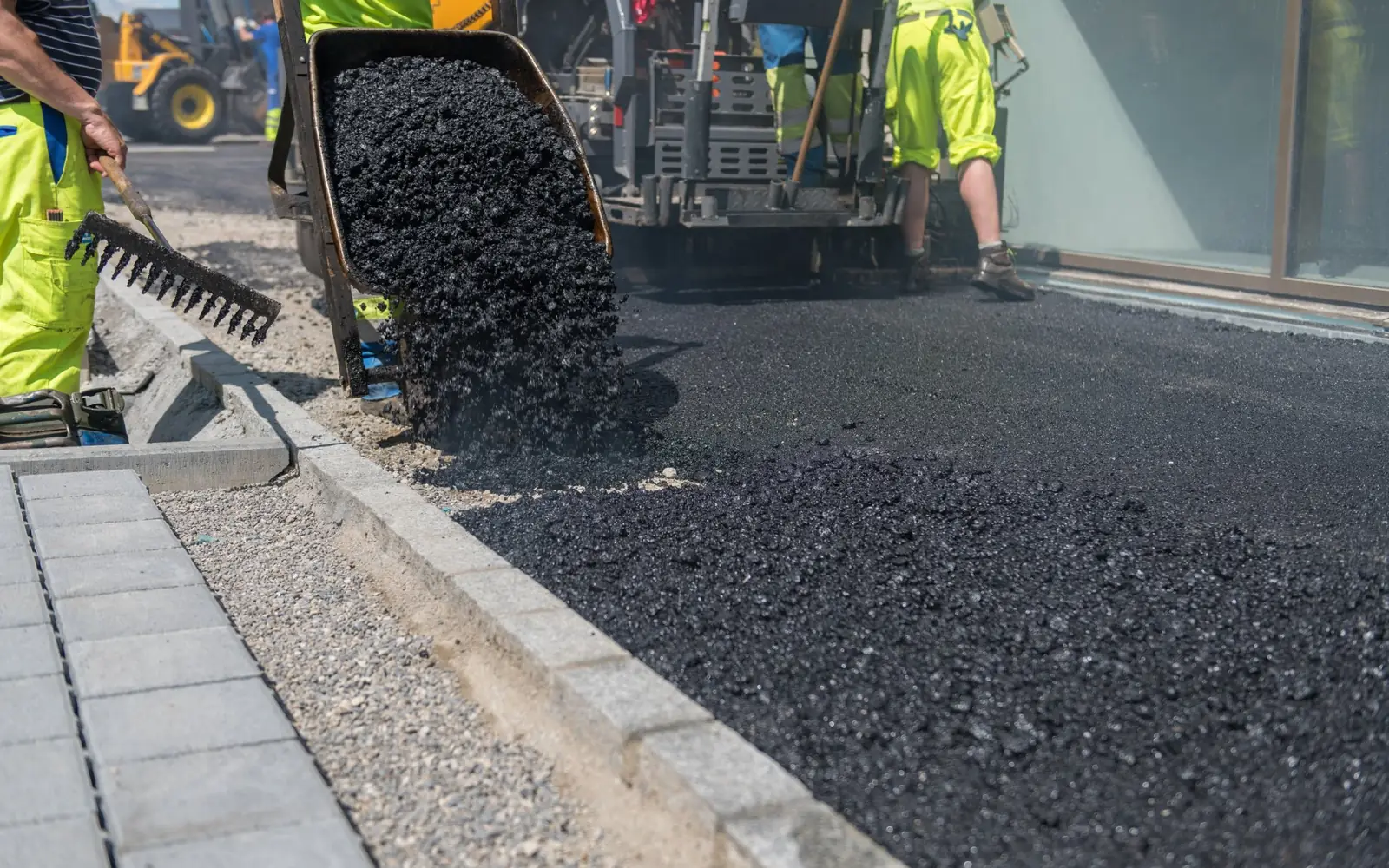
Road Surfacing in Harrogate
Durable, compliant road surfaces built to withstand daily traffic, from new construction and full resurfacing to surface dressing, tar and chip and high-friction finishes. Serving Harrogate and the surrounding North Yorkshire area, call 01423 847027 for a free site visit and no-obligation quote.
Call 01423 847027How soon do you need it?
Selected: Road Surfacing
Reviews
What our customers say
Private & Commercial Road Surfacing Harrogate
A lot of the roads in and around Harrogate were never the council's to mend. The Victorian and Edwardian villas off the main avenues sit on gated drives and shared estate roads that the frontagers own outright, and those surfaces go the same way every time: edges fret away where nothing restrains them, water tracks into the joints, and one hard frost on the higher ground opens a hairline crack into a pothole. Left alone through a winter it only gets dearer to put right.
Welch Surfacing are road surfacing contractors working across Harrogate, from the conservation streets around the Stray out to the business parks on the edge of town and the rural lanes running toward Nidderdale. We surface and resurface private roads, estate roads, gated drives, access roads, commercial yards and country lanes, taking on everything from a single frost-opened pothole through to full reconstruction with drainage, kerbing and markings.
Free site survey and an itemised written quote you can compare against any other contractor.
What We Do
Our road surfacing services in Harrogate
New road construction
including excavation, sub base, binder course, wearing course and edge restraints
Road resurfacing
by planing off the old surface and laying new, where the foundation below is still sound
Surface dressing
a lower cost way to seal and re grip a road that has not yet structurally failed
High friction & anti skid
for junction approaches, bends, crossings and steep gradients
Pothole & edge repairs
cut out square and reinstated, rather than filled and rolled over
Drainage & gullies
including channel drains, regrading and clearing silted systems
Kerbing & dropped kerbs
to hold the edges and control where vehicles cross
Road markings & signage
centre lines, hatching, give way markings, speed roundels and passing place markers
From a worn villa drive off the Stray to an estate road or a business-park yard, these are the jobs we handle most often in Harrogate.
Private & Estate Roads
Private road and estate road surfacing
If your road is unadopted, and a great many of the older residential roads in Harrogate are, keeping it in good order falls to the owners rather than the council. That usually means the frontagers, a residents' association or a management company. Nobody is coming to resurface it for you, but the flip side is that you set the specification and choose the timing instead of sitting on a council programme that may never reach you.
Private roads here tend to wear out faster than the adopted highways alongside them, and for a predictable set of reasons. Many were laid to a lighter build than a public carriageway ever would be. Most have no proper edge restraint, so the sides crumble first. Drainage was often an afterthought on a sloping plot, and delivery vans, builders and the steady traffic to larger homes put loadings through a surface that was never designed to carry them.
We work regularly with residents' groups and management companies, and we understand that the hardest part is often not the surfacing. It is getting a decision made and funded. To help with that we will:
Quote in sections so you can prioritise the worst stretches now and programme the rest later if the budget will not stretch to the whole road
Set out the options side by side typically patching, surface dressing and full resurfacing, so a group can see honestly what each buys and how long it lasts
Provide a written specification you can circulate to residents or trustees and use to compare other tenders fairly
Phase the works to keep access open so residents can get in and out and deliveries and refuse collections still happen
Attend a meeting if it helps since it is usually quicker to answer thirty questions in one evening than by email over three months
Repair or Rebuild?
Resurfacing: overlay, planing and inlay, or full reconstruction
The biggest cost on any road comes down to one question: how far down the failure actually reaches. Guess wrong either way and it costs you. Rebuild a road that only needed a fresh wearing course and the money is wasted, but lay a new surface over a foundation that has already gone and you will be back out there within a couple of Harrogate winters.
The problem is in the surface
- Fretting and ravelling, where the surface has gone loose and gritty and stones come away underfoot
- A polished, shiny surface that has lost its texture and grip but is still level
- Fine cracking with no movement or stepping between the crack edges
- Shallow potholes that have not broken through into the base layers
The foundation has failed
- Crocodile cracking, meaning interconnected cracks in a pattern across a wide area
- Rutting or tramlines following the wheel paths, which points to deformation below the surface
- Depressions that hold water in the same places after every downpour
- Potholes that keep reappearing in the same spot no matter how often they are patched
- Edges breaking away with no kerb or restraint holding them, so the road is getting narrower each year
- Movement or deflection you can feel when a heavy vehicle passes
Where the pattern of failure is not obvious we take core samples rather than guess, because the state of the sub base is the one thing the surface will not tell you. If a plane and inlay is genuinely all your road needs, that is what we will recommend and put in writing, even on jobs where the full reconstruction would have been the larger invoice.
Preventative Treatment
Surface dressing
Surface dressing is a way of protecting a road, not repairing a broken one. A bitumen binder is sprayed over the existing surface, then stone chippings are spread and rolled into it. That seals the road against water getting in, brings back the grip a polished surface has lost, and adds years of life for a fraction of what resurfacing costs, which suits a lot of the lower-traffic estate roads around Harrogate.
- The road is structurally sound but the surface has gone dry, grey and porous
- Grip has dropped off because the surface has polished smooth
- You want to seal fine cracking before water gets into the layers below
- The budget will not cover resurfacing and the aim is to stop the decline rather than reverse it
- There is rutting, deformation or crocodile cracking, since dressing over a structural problem hides it briefly and changes nothing
- The road needs its levels or falls corrected, which dressing cannot do
- There are potholes to deal with first, though these can be patched ahead of dressing
Expect a loose chipping period after the work. Surplus chippings sit on the surface until traffic has bedded them in and the sweeper has been back, which normally takes a few days to a couple of weeks depending on traffic and weather. Drive slowly during that period, both because grip is reduced and because chippings thrown up at speed damage paintwork and windscreens. We put temporary signage out and programme sweeping visits as part of the job.
Against slurry seal, which uses a thinner emulsion and finer aggregate, surface dressing usually gives better durability and grip on a road carrying real daily traffic, while slurry seal can look tidier on lightly used areas like a shared parking court. We will tell you which one actually fits your road when we survey it.
Grip Where It Matters
High friction and anti skid surfacing
High friction surfacing is a specialist treatment that bonds a hard, angular aggregate such as calcined bauxite to the road with a resin binder, giving far more skid resistance than ordinary asphalt. It earns its place where vehicles brake, turn or stop, which in Harrogate tends to be the approach where a private drive or estate road meets a busy avenue, especially on the frost-prone higher ground.
Typical locations on a private or commercial road
Approaches to junctions, gates and give way lines where braking is concentrated
Bends particularly on gradients or where the road is narrow
Pedestrian crossing points school entrances and estate entrances
Steep gradients and ramps where vehicles struggle for grip in the wet or in frost
Yard and loading areas where HGVs manoeuvre alongside people on foot
It is also worth thinking about as a liability question, not just a comfort one. If you own or manage a road, poor skid resistance at a known braking point is a foreseeable risk, and a treated approach is straightforward evidence that it was addressed. Anti skid can be laid in colour where you want the treated area to read clearly to drivers.
Done Properly, Not Patched
Pothole and edge repairs
A pothole is a symptom. Water has worked its way into the layers underneath, softened them, and then frost and traffic have broken the surface open from below.
That is exactly why the cheap fix, tipping material into the hole and rolling it flat, fails so reliably: the path the water took is still there, and the patch is only ever as sound as whatever it was laid against.
We cut repairs out square to sound material, clean and tack the edges, then reinstate and compact in layers so the patch bonds properly and sheds water the way the road around it does. Where potholes keep coming back in the same spot we look for the cause, which on these sloping Harrogate plots is usually drainage or a tired sub base, and we tell you straight if more patching is just money going nowhere.
Edge repairs matter far more than people expect. Once the unrestrained side of a road starts to break away, the usable width narrows, traffic is pushed toward the middle and the damage speeds up. Reinstating the edge and adding kerbing or a restraint stops that cycle before it eats the road.
Markings & Kerbing
Road markings, kerbing and dropped kerbs
Road markings centre and edge lines, give way and stop markings, hatching, keep clear zones, arrows, speed limit roundels and passing place markers
Kerbing and edgings to restrain the surface, define the carriageway and direct surface water toward gullies
Dropped kerbs and crossings for vehicle access and level pedestrian routes, subject to the relevant permissions where a public highway is involved
Thermoplastic or paint markings chosen for the traffic level and how long the markings need to last
On a private road, clear markings quietly do a lot of work. Marked passing places, a defined turning area and a few no parking zones take most of the friction out of day to day life between neighbours, and they keep the way clear for refuse lorries and emergency vehicles on a narrow Harrogate estate road.
Materials & Spec
Surfacing materials and specification
A road is a layered structure and the part you can see is the thinnest of it. Below the surface sits a binder course that carries and spreads the load, and under that a compacted sub base that does the real structural work. Get the depths and the material grades right and the road lasts for years. Get them wrong and no quality in the top layer will save it.
Asphalt & tarmac
The standard choice for roads, laid as a binder course and wearing course. Fast to lay, quick to reopen, straightforward to repair and to plane off and replace later.
Heavier duty build ups
Heavier duty binder courses and deeper build ups where the road carries HGVs, farm machinery, refuse vehicles or regular deliveries rather than cars alone.
Concrete
For short, heavily loaded sections such as bin collection points, weighbridges and turning areas where vehicles pivot on the spot.
Dressing & high friction
Surface dressing and high friction systems as treatments applied to a sound existing road rather than alternatives to construction.
Our quotes set out the layer depths and the material specification rather than just naming the finish, so you can see precisely what you are paying for and put it fairly alongside any other tender you are weighing up.
Keeping The Road Open
Traffic management and keeping the road open
On most of the roads we work on, closing the whole thing is not an option. Residents need to get in and out, businesses need deliveries and nobody wants to explain to an ambulance crew why the access is blocked.
Where a public highway is affected, permits and traffic management orders come from the local authority, and we will tell you at survey stage what your scheme is likely to need.
We plan this before we start
- Phasing so the road is worked in sections and a route stays available throughout wherever the width allows
- Written notice and a programme you can circulate to residents or tenants, so people know which days affect them
- Signage, barriers and banksmen as appropriate to the site, with pedestrians kept separated from plant
- Timed access windows for deliveries, refuse collections and school runs where these cannot move
- Emergency access maintained at all times
- Out of hours or weekend working where the site and local restrictions allow it
Transparent Pricing
How much does road surfacing cost in Harrogate?
Roads are priced from a survey, because the things that move the cost most are the ones you cannot read off the surface. As a rough order, patching sits at the bottom, surface dressing above it, planing and inlay above that, and full excavation and reconstruction at the top. Drainage, kerbing, markings and high friction are each priced on their own, per item or per linear metre.
What moves the number on your road
Length and width, larger areas bring the rate per square metre down
Foundation condition, and how deep the excavation has to go
Loading, a road carrying HGVs or farm machinery needs a heavier build up than one carrying cars
Drainage, both what already exists and what the road actually needs
Access, whether plant and lorries can reach the site easily and where the arisings go
Traffic management, phased working around live access costs more than a full closure
Permits and highway licences, where a public road or footway is affected
Extras, such as kerbing, markings, high friction sections and gully work
Every quote is itemised, so surfacing, drainage, kerbing, markings and disposal are all priced separately and you can see exactly where the money goes. That also makes it straightforward to drop or defer an element if the budget needs managing.
FAQs
Frequently asked questions
How long before we can drive on a newly surfaced road?
How long will the work take and how disruptive is it?
Will residents still be able to get in and out?
Who is responsible for maintaining a private road?
Do we need permission to resurface a private road?
Can we split the road into phases and spread the cost?
How do we know whether to patch, dress or resurface?
Why are the chippings loose after surface dressing, and how long does that last?
Can you surface a road that HGVs, tractors or refuse vehicles use?
Can you work in winter?
What happens if you find something unexpected once the surface is off?
What maintenance makes a road last longest?
No Obligation
Book your free road survey
Whether it is a villa drive fretting at the edges, an estate road near the Stray that nobody can agree how to fund, or a Nidderdale lane that has to carry more than it was ever built for, the first step costs nothing. We will walk the road with you in Harrogate, assess it properly and give you clear options with an itemised written quote and no obligation.
Our Process
Our Road Surfacing process in Harrogate
Roads are rarely worked on in isolation, so we plan around traffic, access and safety from the outset.
Site assessment
We visit to assess the existing surface, ground conditions and any access or traffic management requirements.
Why Choose Us
Why Choose Welch Surfacing for your Road Surfacing
Whether you are a private road owner, managing agent or local authority, choosing a road surfacing contractor means trusting them to specify and deliver the right solution safely and to standard.
- Trained and certified operatives on every job, working to recognised industry standards
- Fully insured for private, commercial and public sector road works
- Experience across surfacing methods, from full resurfacing to surface dressing and tar and chip
- Proper site assessment before specification, so you get the right method for your road, not a default one
- Appropriate traffic management and signage included as standard where required
Serving Harrogate
Road Surfacing across Harrogate & the surrounding area
Call our Harrogate team on 01423 847027 for a free site visit and quote.
Looking for a service other than road surfacing in Harrogate?
We provide a whole range of surfacing options for our Harrogate clients:
Not in Harrogate? Still looking for road surfacing near you?
Including Newcastle upon Tyne, Consett, Durham, Middlesbrough, Darlington and more: